

This page describes somecommon end-to-end flows in Elements. These flows show how features work together over time, rather than focusing on individual APIs. In these flows, authoritative code may live inside a Custom Element, which can act as the core game server.
If you are new to backend or server-side concepts, start here. You do not need to understand every API to follow these diagrams.
How to Read These Flows #
Each flow is shown as a sequence of steps:
- Client – code running on the player’s device (UI, input)
- Authoritative Code – your server or a Custom Element
- Elements – the platform applying and enforcing state
The same flow applies whether your authoritative code runs on:
- your own game server, or
- a Custom Element inside Elements
Reward Lifecycle #
Rewards in Elements are deliberately split into issuance and redemption. This prevents duplication and gives you control over when rewards are applied.
Typical Reward Flow #

Why This Exists #
- Prevents duplicate rewards
- Allows safe retries
- Supports delayed claiming (reward screens, inboxes)
- Makes reward application auditable
Common Variations #
- Immediate rewards: issuance and redemption happen back-to-back
- Delayed rewards: issuance happens first, redemption later
- One-time rewards: persistent issuances prevent duplicates
Mission and Progress Lifecycle #
Missions define what can be done. Progress tracks what a player has done.
Typical Mission Flow #

Key Concepts #
- Missions are copied into progress; later edits do not affect existing players
- Progress is advanced only by authoritative code
- Step completion can trigger reward issuance
Common Variations #
- Repeatable missions: progress resets after completion
- Scheduled missions: assignment is controlled by Schedules
- Parallel missions: multiple missions active at the same time
Schedule Lifecycle #
Schedules control when missions are active.
Typical Schedule Flow #
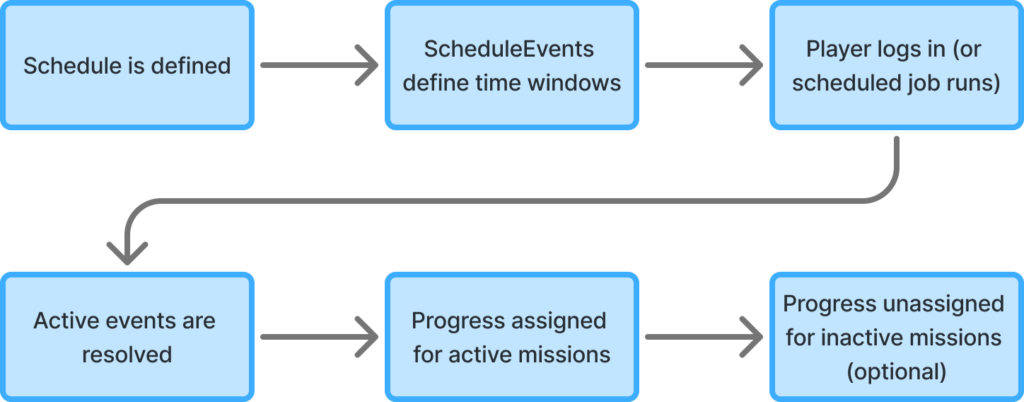
Why Scheduling Is Separate #
- Allows time-based content without hardcoding dates
- Supports seasonal and rotating content
- Makes mission assignment safe to repeat
Schedules do not track player progress themselves — they only control assignment.
Leaderboard Lifecycle #
Leaderboards track and rank player scores over time.
Typical Leaderboard Flow #

Epochal Leaderboards #
For resetting leaderboards:

Epoch handling is automatic once configured.
Putting It All Together #
Many production systems combine multiple flows:

Elements is designed so these operations are:
- safe to retry
- resistant to duplication
- auditable
What to Read Next #
After understanding these flows:
- See Rewards & Digital Goods to dive deeper into issuance and inventory
- See Progress & Missions for detailed mission configuration
- See Leaderboards for ranking and social queries
If you’re unsure where code should live, review Why You Need a Server and Custom Elements in General Concepts.